
The quick-service restaurant market is under increasing pressure to protect margins while maintaining value for increasingly price-conscious customers. For large quick-service restaurant chains, tracking competitor menu prices can provide an important source of market intelligence. It helps pricing teams identify where they are competitively positioned and the opportunities available.
Yet, knowing the menu prices is only part of the challenge. Prices can, and should, vary by location, product, channel and promotion. A traditional twice-yearly pricing review is no longer enough to maintain competitiveness in this fast-changing environment.
When you track competitor menu prices regularly, you have a clear view of how the market is changing. Combine this with your sales data, pricing and wider market intelligence, and your quick service restaurant can make more informed decisions.
You need to know what your competitors are charging so that you can develop an effective pricing and promotional strategy. Pizza provides a useful example. It is a highly competitive area of the quick-service restaurant market, and Meaningful Vision data shows that the category is experiencing a decline in footfall.
When a major player such as Domino’s reduces prices or introduces a new offer, other operators need to understand what this means for their own competitive position. Often, other pizza restaurants will follow the trend set by the market leader. Yet, it is not always the case that one restaurant drops or raises prices and every other brand should follow.
Having access to competitor menu prices will help you identify market shifts much faster. This will give you more scope to adjust your pricing policy. Moreover, the market is changing at speed: beef prices increased last year; this year’s heatwave impacts fruit, vegetable and other category costs; and margins are tight. If the segment leader increases prices, it is a good signal to follow suit so that you can secure the margins.
In practice, many pricing teams still do this manually, checking competitor apps and websites by hand, which limits how often and how broadly they can realistically track prices.
Complexity of Menu Pricing
Menu pricing data is complex. You can have the same item at different prices depending on location, channels, promotions, and other variables such as product size. This means that when you look at a competitor’s menu price, you need to ensure you are comparing the right data.
Treat competitor menu prices as pricing intelligence, rather than a price list with which to compete. Different cities demand different prices. A burger at one location could be 25% more expensive than in another. This reflects the local demand, competition and pricing sensitivity. Variable pricing is a great tool, but deployment is complicated. Therefore, understanding competitor data can help you decide on the price zone or tiers which make sense for your brand.
Equally, track the right competitors. Knowing where you sit in the market is essential to ensure that you’re tracking the true decision-making that your customers are making when deciding whether to go to restaurant A or B.
Likewise, bringing this to a location level may give you different competitors. Customers are not necessarily the same in one location as they are in another. When you start looking at the granular data, the question can arise of how you can achieve results at scale. It can be difficult to maintain the monitoring of various channels, locations and offers across marketing.
Automated competitor pricing intelligence can provide a more consistent and timely view of market changes, allowing you to look at a broader range of competitors. As the market is declining, consumers are increasingly price-conscious. Your competitor is not simply the other brands in your category. A burger chain is also competing against chicken, kebabs, burritos and so on. It is no longer enough to track your top three competitors; you need a wider view of the quick-service restaurant market.
When looking at menu prices, it goes far beyond the standard price displayed next to a product. You want to be analysing the full price, but also meal and combo offers, family and group promotions, and how add-ons and modifiers change the value proposition. As do limited-time offers, which consumers are ready to pay a premium for, and these can also be tracked. By watching how often and when menu price changes are happening, you can get an overview of how to better compete.
The difficulty is that this information is changing fast. Some promos only run for a few days. Limited time offers are available through price tracking
Delivery platform pricing
You also need to be looking at delivery prices. Within this area, there are also variables such as delivery platform fees, which are not equal across the board. Quick-service restaurants can be paying anything between 10-30% in platform fees. This will impact the pricing and offers that they can make. Equally, knowing this information can be helpful to your negotiations with delivery platforms when it comes to your delivery premiums, to ensure that you are getting the best deal. Equally, you need to be aware of what promotions brands are running specifically for delivery platforms.
App Pricing
You would also need to consider in-app offers and pricing, any promotions that are running and limited-time offers. Again, these are increasing, and you would want to look at how many items are being promoted for loyal customers, how often and how generous those offers are. Some discounts over the summer period went up to 30% for app users. These are big discounts that need to be taken into account.
All of these variables can impact the true picture of what you see as a menu price. When you look at this across multiple competitors, you can get a better overview of what is happening in the market and make better decisions for your brand.
Once you have the data in place, knowing what to look for is another area. The easiest area to assess is whether you are priced above or below your key competitors. If your pricing is too high, you may be losing footfall based on cost. Too low, and you could be missing out on price growth.
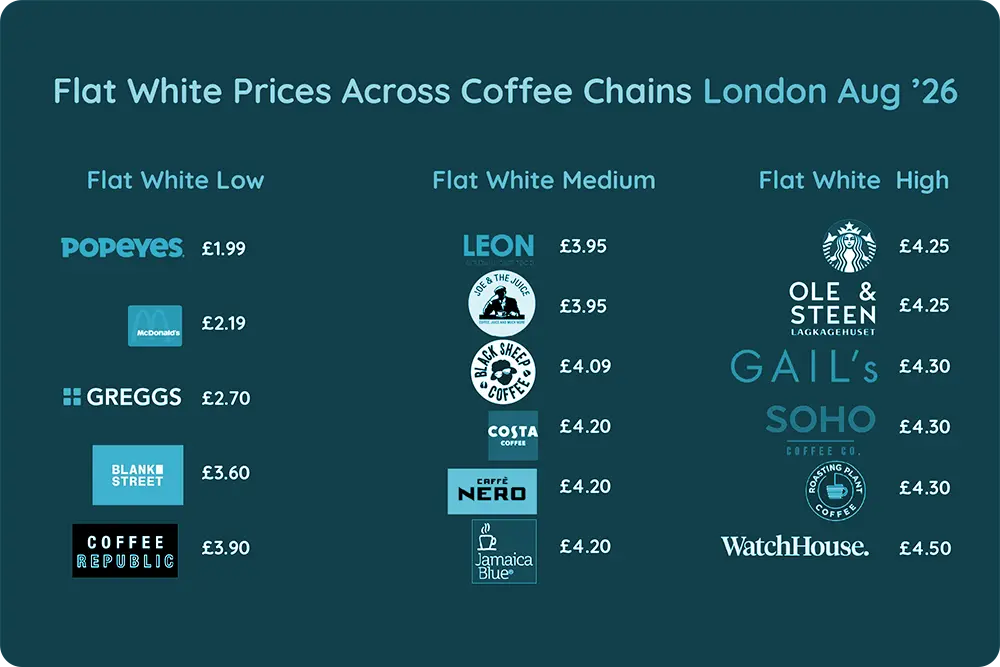
Coffee is a good example, as the same product can differ across brands and locations. If your coffee is at the high end of the scale, then you need to have the branding and product to match. At the bottom end, you may be competing with new entrants into the market such as Popeye’s and McDonald’s, who offer good, cheap coffee as part of their menus.
Meaningful Vision data shows that the middle of the coffee market is feeling the squeeze right now. Knowing which way to push pricing when you are in the middle, and the other variables such as positioning and messaging, can all be helped by understanding where your customers are going. Is it towards Popeye’s and McDonald’s? Or heading to more premium brands like Gail’s?
This should also open location-based discussions. Prices change according to location. Continuing the coffee example, people are willing to pay more for coffee at train stations and motorway services because they are limited in options. If you are offering the same price as on the high street, you are missing out on profit. Likewise, what you can charge in one location may not work in another.
You can also analyse what products are the most price-sensitive. This will give you insights into which product pricing should get your focus. Regular price changes may also be the result of promotions rather than permanent price reductions; this is another factor that you can take into account.
Meaningful Vision gives you market intelligence that can help analyse consumer behaviour alongside pricing, which will allow you to set the strategy in line with your value proposition.
Core product prices
- Burgers
- Chicken
- Pizza
- Sandwiches
- Breakfast
- Sides
- Desserts
- Drinks
Basket-level pricing
- Individual item
- Size
- Meals
- Family bundle
- Add-ons
Promotional pricing
- Discounts
- Meal deals
- Limited-time offers
- Loyalty offers
- Free products
Channel pricing
- Dine In
- Take away
- Delivery
- Define the competitors
You should have direct competitors, but also look at brands that may be moving into the market or offer similar products. Look at where your customers may be moving, either to more value products or high-end. You should also look at competitors by location.
- Identify the comparable products
As well as like-for-like products, you should also be comparing equivalent sizes and meal formats. You will want to look at bundles and offers within this.
- Capture the relevant price
As well as the headline price, you need to have a view on the promotional offers, what is charged in-store or by delivery app and location-specific pricing.
- Analyse the data
Getting an overview of the product range by size, the channels and any promotional status will give you a clear view of what is happening across the market.
- Calculate the price gap
You will want to see the absolute difference, the percentage difference, and the position against the market average.
- Segment the results
Look at by location, product, daypart, channel and competitor
- Set the strategy
Use the market insights to set your pricing strategy and review process.
Having a clear analysis of competitor menu pricing will help you create better pricing strategies, as you will not simply be following the market leader and competing solely on price.
This is dependent on the market in which you operate. Daily monitoring is relevant for highly dynamic categories, and weekly monitoring will support active markets. Whereas, monthly monitoring is suitable for strategic analysis. You should have quarterly deeper pricing reviews that help set your longer-term strategy.
We know that some brands are analysing and changing their prices twice a year. This is not nearly enough to be competitive. Quarterly analysis may work for casual dining and pubs, but fast food restaurants need to increase the frequency. New competitors arrive regularly, and promotional activities are increasing.
The frequency should be guided by how quickly your competitors change their menu prices. Promotions change on a different cadence from permanent prices. It is important that you monitor national chains on a local level, as Meaningful Vision data shows, the national picture could be distorted by what is happening at a local level.
Location is essential when it comes to analysing menu prices. Income differs across the country, as do house prices and disposable income. For your brand, location also comes with overhead variables such as rent and operating costs.
Depending on what products you are comparing, you also need to assess how the dayparts impact pricing. We know that some brands, such as Pret-A-Manger, are testing reduced pricing on bakery goods during the last hour of the day in certain locations. This can have implications on your brand, depending on the product and consumer behaviour.
Understanding how menu prices may be changing by daypart can help you adapt to changing behaviours and address any footfall opportunities.
It is unlikely that you will encounter consistent pricing across all channels. Adjusting pricing according to eat-in, take-away, click & collect, delivery or in-app can depend on multiple factors. We have already touched on the difference in fees across delivery partners. Mobile apps can reward loyal customers and mean reducing prices for only some people. You can also set delivery and click & collect offers to encourage purchases. Dine-in and takeaway pricing is often different as there are fewer overheads for takeaway beyond the takeaway packaging costs.
These variables are another reason why tracking competitor menu prices is complex but necessary if you want to highlight the best possible pricing for your brand.
No, not as a blanket strategy. You need to look at the price, the context, the perceived value and then take into account your costs, profit margin and any promotional offers, campaigns or bundles.
As we have already touched on, there are many overheads like ingredient costs, labour, packaging, rent, platform fees, and so forth. Menu pricing is only one area of a much bigger set of variables which can influence your pricing decisions.
Tracking competitor menu prices should form a reference point rather than a formula in itself. You need to understand whether the prices are permanent or promotional, the impact of the local environment, the impact of daypart and customer price sensitivity before making decisions on your menu pricing.
10 questions your pricing team should ask
- What are our closest competitors charging for comparable products?
- Where are our biggest price gaps and in which stores?
- Which products have the largest competitive price gaps?
- Are our price gaps consistent across locations?
- Which competitors are changing prices most frequently?
- Are price changes permanent or promotional?
- How are competitors pricing differently across channels?
- Where are we priced above the market?
- Where are we priced below the market?
- Which price changes are creating a potential opportunity for us?
Many quick-service restaurants still rely on manual price checks: Staff logging into competitor apps and websites to record prices by hand. This does not scale; it may create human error; and it cannot keep pace with a market where prices and promotions change daily. It also ties up time that pricing teams could spend acting on the data rather than collecting it.
Our market intelligence software and expertise automates this collection, giving you a greater understanding of competitor menu prices and the relevant data that can inform your pricing. We understand how granular data can give you a different perspective on market changes and the commercial advantages of being proactive around pricing rather than following the market leader. This can help you identify better pricing opportunities and increase market share.
Get in touch with our team to find out how Meaningful Vision can help your quick-service restaurant better track competitor menu prices.

CEO, Meaningful Vision