

The UK fast-food industry is having a difficult year. Footfall across fast-food restaurants fell 0.9% in the first six months of 2026, compared with 0.6% growth in the same period last year. Yet one format is moving firmly in the opposite direction: the chicken shop.
Amelia Dimoldenberg may have called time on Chicken Shop Date after more than a decade, but chicken restaurants are fast becoming the UK’s most popular fast-food format. Younger consumers on tighter budgets are choosing wings, tenders and dips over a night at the pub. At the same time, soft drinks and TikTok food trends are reshaping menus across the UK eating out market.
At Meaningful Vision, we track customer visits, pricing, promotions and store openings at 60,000 outlets run by the UK’s top 300 fast-food, pub and casual dining brands. Here is what our data shows about the brands bucking the high-street downturn, and what quick service restaurants can learn from them.
Why chicken shops are outperforming the UK fast-food market
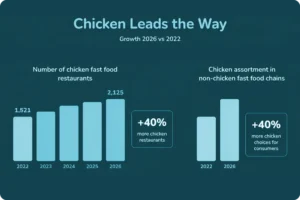
Chicken shops increased footfall by 8.9% in H1 2026. They were one of only two segments in the fast food market to grow at all. The other, ethnic cuisine restaurants, grew 4.2%, so chicken grew at more than twice the rate.
Competition in the category is also heating up, as US quick service restaurant chains move into the UK:
- Dave’s Hot Chicken launched in December 2024.
- Chick-fil-A opened in Belfast in January 2025.
- Houston Hot Chicken, part of the Pizza Express group, is due to launch in Stevenage in October 2026.
- Raising Cane’s is planning a Piccadilly Circus flagship later this year.
For existing operators, this means more pressure on pricing, promotions and location strategy. As we have seen before, the chicken battle is local, and national averages can hide what is happening at street level.
Why is Gen Z choosing chicken shops?
There are several reasons behind the rising popularity of chicken shops, and the first is money. The job market is difficult for younger people. According to the Office for National Statistics, an estimated 981,000 people aged 16 to 24 were not in education, employment or training (NEET) in April to June 2026. That is up 30,000 on the same period in 2025, and around 50% higher than in 2021.
With tighter budgets, a meal at £10–£15 makes chicken shops a much cheaper night out than the pub or a casual dining restaurant. But price is only part of the story. The format is built for how younger consumers want to socialise right now:
- Cultural relevance: US brands such as Wingstop, Popeyes and Dave’s Hot Chicken bring TikTok buzz with them.
- Built for groups: Wings, tenders, loaded fries and dips are easy to share, giving the format a more social feel.
- Flavour and novelty: Sauces, spice levels and limited-time offers keep customers coming back to try something new.
- Social-media friendly: Visual food and spicy challenges drive hype online.
- Flexibility: There is no booking, service is quick, and it is an easy place to meet friends.
Put together, these factors make the chicken shop the new hangout for Gen Z, and in many cases a replacement for the pub.
Are quick service restaurants replacing the pub?
Pub footfall has continued to decline in 2026, with only a brief respite during the World Cup. Visits in May were down 7.4% year on year, June improved to -5.5%, and July turned narrowly positive at +0.2%.
We expect that improvement to be short-lived. There is conflicting data about Gen Z’s drinking habits, but what is clear is that people are visiting the pub less often. Younger consumers are moving their socialising to eateries and coffee shops instead:
- Fast-food footfall after 6pm has grown 5.1%.
- Up to 10% of coffee shop visits now take place in the evening.
Fast-food and coffee shop operators see this as an opportunity. They are offering far more choice to consumers who want to socialise somewhere other than the pub, and drinks are at the heart of it.
Why soft drinks are becoming a growth lever
Soft drinks are now a growth lever for hospitality operators across every format. Our menu data shows how far the range of cold drinks has expanded:
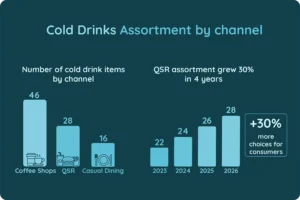
The innovation goes well beyond coffee and cola. Collagen drinks, protein drinks, fibre-enriched drinks, matcha, mushroom-based drinks, CBD drinks and craft lemonades are all emerging as new growth drivers on menus. For anyone following food and beverage trends, drinks are now one of the fastest-moving parts of the menu.
Matcha: from niche to mainstream
Matcha deserves a special mention because the numbers are impressive. The number of matcha-flavoured drinks on menus has doubled in two years, reaching 16 different options in June 2026.
Matcha also commands a 25% price premium, and consumers are paying it without pushback. It is a good example of how quickly a trend can scale once it catches on, and of why drinks deserve a place in your pricing strategy.
Social trends are converting into real menu items faster than they used to. Watching TikTok today is genuinely a leading indicator for menus tomorrow.
Two of last year’s TikTok food trends are already showing up on menus in a significant way. Cloud coffee and ube have both moved from social virality into adoption at food and drink outlets, and more will follow.
Which food and drink trends should you watch?
Keep an eye on ‘fricy’ (fried-spicy) and ‘swicy’ (sweet-spicy) combinations. They are showing up through Japanese and Korean sauces and dirty sodas, helped by the growing influence of K-Pop and other cultural factors on younger audiences.
These are early-stage trends. But based on the pattern we saw with matcha and cloud coffee, they are exactly the kind of signal worth noting for the rest of 2026 and into next year.
What this means for quick service restaurants
The fast-food market is not declining evenly. Some formats, dayparts and menu categories are growing while others shrink. For QSR restaurants, the brands that win will be the ones that spot these shifts early and act on them. That means keeping a close eye on:
- Footfall by format and daypart, including the growing evening opportunity.
- New market entrants, especially US chicken chains opening in your locations.
- Menu changes, such as how many cold drinks and limited-time offers competitors are adding.
- Pricing and premiums, from £10–£15 meal price points to the 25% premium on matcha.
- Social trends, and how quickly they move from TikTok onto competitor menus.
Tracking all of this by hand is not realistic for most teams. As we explained in our guide on how to track competitor menu prices, manual checks cannot keep pace with a market where menus and promotions change daily.
How Meaningful Vision helps you stay ahead of food and drink trends
Meaningful Vision provides foodservice market intelligence across 60,000 outlets run by the UK’s top 300 fast-food, pub and casual dining brands. Our restaurant footfall data, menu tracking, pricing and promotions data show you where customers are going, what competitors are charging and which trends are turning into real menu items.
That gives your team a clear view of the quick service industry at national and local level, so you can act on change rather than react to it. Explore our market intelligence reports for more on the UK eating out market, or get in touch with our team to find out how Meaningful Vision can help your brand.

CEO, Meaningful Vision