
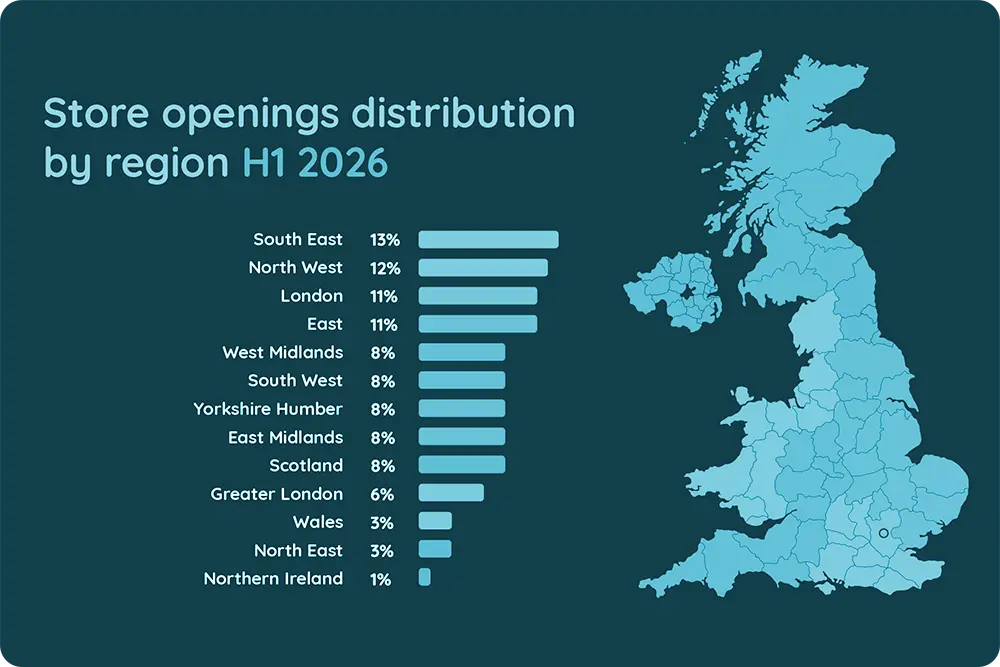
Meaningful Vision data shows a sharply divided regional picture for UK foodservice in H1 2026.
Only five of the UK’s 13 regions recorded year-on-year growth in foodservice traffic, while eight remained in decline. The South West led with visits up 5.5%, followed by Greater London at 4.2% and the South East at 3.1%. London also returned to modest growth of 0.4%, while Northern Ireland was just positive at 0.1%.
At the other end of the market, Wales recorded the steepest decline at 9.1%, followed by Scotland at 8.2%, Yorkshire and Humber at 7.9%, and the North West at 7.5%.
This regional split matters because the UK foodservice market as a whole declined by 2.2% in the first half of the year. That national average does not reflect what operators are seeing in every local market.
Southern regions are outperforming
The South West was the strongest-performing region, with traffic growth accelerating from 4.1% in H1 2025 to 5.5% in H1 2026.
Greater London followed at 4.2%, while the South East grew by 3.1%.
London also improved materially. Foodservice visits increased by 0.4% in H1 2026 after falling by 3.1% in the same period last year.
Northern Ireland moved in the opposite direction. It was the strongest-performing region in H1 2025, with traffic growth of 8.4%, but slowed to just 0.1% this year. Last year’s performance had been supported by new store openings.
Domestic tourism may be one factor supporting stronger performance in southern regions. More UK staycations could be helping restaurant footfall in the South West, South East and London, although this should be treated as one possible contributor rather than the only explanation.
Much of the UK remains under pressure
The regional picture becomes much weaker outside the five growth markets.
Wales recorded the steepest fall in foodservice traffic, down 9.1% year on year. Scotland declined by 8.2%, Yorkshire and Humber by 7.9%, and the North West by 7.5%.
The North East fell by 6.8% and the West Midlands by 6.5%. Even the East, the strongest-performing region outside the five growth markets, remained 2.2% below last year.
These figures cover consumer visits across restaurants, pubs and quick-service foodservice. Pubs and restaurants have experienced steeper declines than QSR, which may also influence regional performance.
The important point for operators is that regional foodservice trends are now moving in very different directions.
Why regional foodservice intelligence matters
A national average tells operators almost nothing useful on its own right now.
Five regions are growing, eight are declining, and the gap between the best and worst performer is more than 14 percentage points.
Local tourism, store density, competitive activity and consumer spending behaviour can all shape performance differently from one region to another. That is why decisions about new sites, promotions and investment should be based on local evidence rather than national averages.
At Meaningful Vision, our foodservice market intelligence combines regional traffic, outlet density and competitive analysis to provide location intelligence at both market and local level.
For operators, that means being able to see where consumer demand is recovering, where competition is intensifying and which regions may offer stronger opportunities for future investment.
The question for H2 2026 is whether growth can spread beyond the South, or whether the regional gap will widen further.