
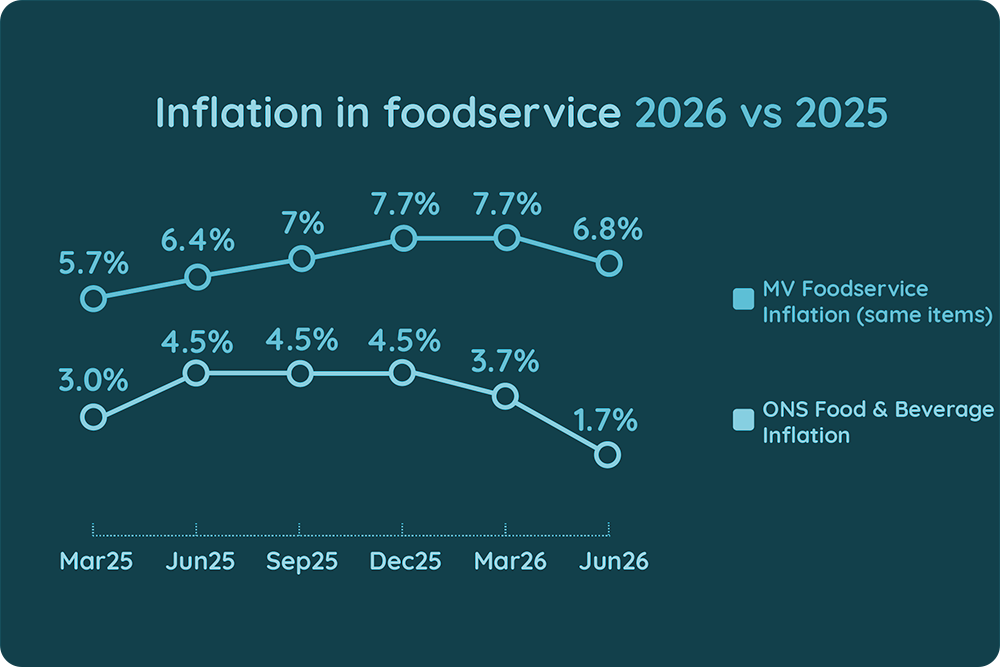
UK foodservice inflation eased to 6.8% year on year in June 2026, but restaurant prices are still rising much faster than food and beverage prices in retail.
Meaningful Vision’s same-item foodservice pricing data shows inflation increased from 5.7% in March 2025 to 6.4% in June and 7.0% in September. It reached 7.7% in December 2025, remained at 7.7% in March 2026 and then eased to 6.8% in June.
The retail trend has moved much faster in the opposite direction. ONS food and beverage inflation increased from 3.0% in March 2025 to 4.5% in June and remained at 4.5% through December. It then fell to 3.7% in March 2026 and just 1.7% in June.
As a result, UK foodservice inflation was four times the retail food and beverage rate in June.
Extras, bakery and hot drinks lead price growth
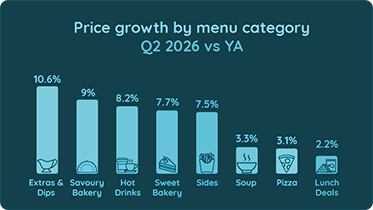
The 6.8% headline figure hides an 8.4 percentage-point gap between the fastest and slowest-growing menu categories.
Extras and dips recorded the strongest increase in Q2 2026 at 10.6% year on year. Savoury bakery followed at 9.0%, with hot drinks at 8.2%. Sweet bakery prices increased by 7.7% and sides by 7.5%, putting all five categories above the overall foodservice inflation rate.
Price increases were much lower elsewhere on the menu. Soup rose by 3.3%, pizza by 3.1% and lunch deals by only 2.2%.
A single inflation rate cannot show which categories are absorbing the largest price increases or where competitors are moving prices more cautiously.
Category-level foodservice pricing data provides a more useful benchmark for assessing price position, customer value and margin decisions.
Delivery inflation remains higher than dine-in
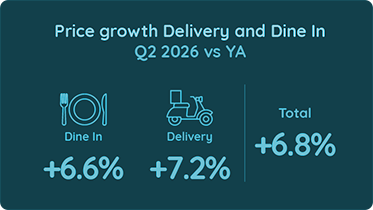
The sales channel creates another pricing gap.
Delivery menu prices increased by 7.2% year on year, compared with 6.6% for dine-in. Operators therefore need to track delivery separately rather than assume that price changes are moving at the same rate across channels.
Foodservice inflation is starting to come down, but operators and consumers are not seeing the same change across every part of the menu. Extras, bakery and hot drinks are still recording increases well above the overall rate, while pizza and lunch deals are moving much more slowly.
For H2, operators need to compare pricing by category and channel, not just against the overall market average. The important question is where competitors are continuing to increase prices and where those increases are starting to stabilise.
What should operators be tracking in H2 2026?
As H2 progresses, operators should be watching whether the highest-inflation categories begin to slow, whether delivery continues to outpace dine-in pricing and whether categories such as pizza and lunch deals remain relatively stable.
Meaningful Vision’s foodservice market intelligence tracks menu prices, delivery mark-ups and competitor movements across the UK quick service restaurants, helping QSR operators benchmark their pricing against the market at category, brand and channel level.

Maria Vanifatova
CEO, Meaningful Vision